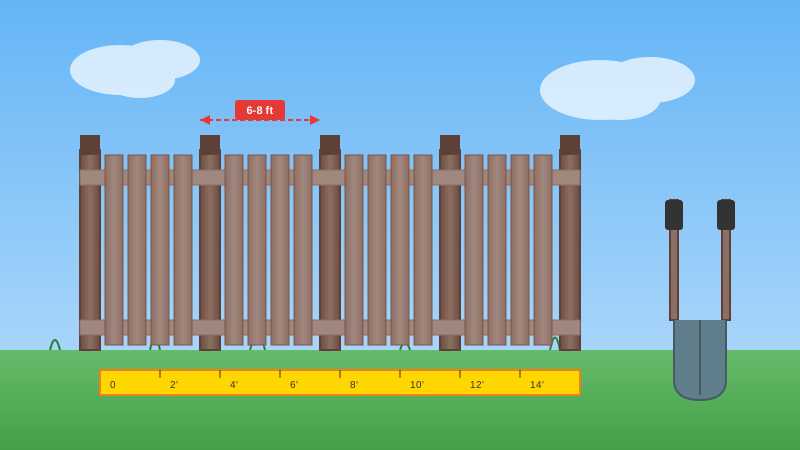
The right fence material is rarely just a style choice. It affects:
- the cost per linear foot,
- how much maintenance you take on,
- how much privacy you get,
- how often you repair it,
- and how long the fence lasts before replacement.
That is why many homeowners start with a broad question like “What fence should I build?” and end up comparing only three realistic choices:
- wood for privacy and a natural look,
- vinyl for lower maintenance,
- chain link for budget and durability.
If you already know your layout, run the Fencing Calculator first. This guide helps you decide which material belongs in that estimate before you buy posts, rails, panels, or concrete.
Quick Comparison Table
Use this table as a planning shortcut before you dive into full quotes.
| Fence Type | Typical DIY Material Cost | Typical Installed Cost | Privacy | Maintenance | Common Lifespan |
|---|---|---|---|---|---|
| Chain link | $6-12 / linear ft | $12-25 / linear ft | Low | Low | 15-30 years |
| Wood privacy | $15-25 / linear ft | $31-54 / linear ft | High | Medium to high | 15-40 years |
| Vinyl privacy | $18-35 / linear ft | $25-40 / linear ft | High | Low | 20-30 years |
These are planning ranges, not exact bids. Gates, slopes, corners, premium hardware, post depth, demo, and local labor can move the total up quickly.
When Wood Fence Is the Best Choice
Wood is still the default answer for many backyards because it solves the biggest emotional use case: privacy with a warm, residential look.
Wood usually wins when you care most about:
- full backyard privacy,
- a traditional appearance,
- easier customization,
- stain or paint flexibility,
- and panel-by-panel repairs.
Why homeowners still choose wood
-
It looks the most natural.
Cedar and redwood especially fit residential landscapes better than chain link. -
It is easy to customize.
You can change picket spacing, rail layout, trim caps, height transitions, and decorative tops. -
Repairs can be localized.
A damaged board or rail is often easier to replace than a whole prefabricated section.
What buyers underestimate about wood
Wood rarely stays “cheap” if you own it long enough. Maintenance often includes:
- staining or sealing,
- replacing warped or split boards,
- dealing with ground contact rot,
- and correcting leaning sections when posts fail early.
If you like the look of wood but do not want a high-maintenance fence, that is usually when vinyl enters the conversation.
When Vinyl Fence Is the Better Decision
Vinyl is often the answer for homeowners who want privacy without repeated upkeep.
Vinyl usually wins when you want:
- a clean, uniform finish,
- no painting or staining,
- lower routine maintenance,
- long-term residential curb appeal,
- and predictable appearance over time.
The main advantage of vinyl
The biggest benefit is less ongoing maintenance. You do not typically need to sand, stain, or repaint it. Cleaning often comes down to a hose, mild soap, and occasional spot treatment.
The tradeoff with vinyl
The up-front material cost is usually higher than basic pressure-treated wood. Repairs can also be less flexible because systems are often panel-based and manufacturer-specific.
That means vinyl often works best for owners who think in 5- to 15-year ownership terms, not just the first install cost.
A good rule of thumb
If your top priority is privacy plus low maintenance, vinyl is one of the strongest default options.
When Chain Link Is the Smartest Use of Budget
Chain link is rarely the prettiest fence, but it solves a different problem extremely well: durable enclosure at the lowest practical cost.
Chain link usually wins when you need:
- perimeter security on a budget,
- pet containment,
- backyard boundary marking,
- durable low-maintenance enclosure,
- or large linear footage at lower cost.
Why chain link remains popular
-
It is economical for long runs.
If you are fencing 150, 250, or 400 linear feet, cost differences compound quickly. -
It is durable.
Galvanized and coated systems can last a long time with minimal upkeep. -
It works well for utility fencing.
Side yards, dog runs, and large property boundaries often do not justify premium privacy material.
Why chain link loses some buyers
Its biggest limitation is obvious: it does not provide true privacy unless you add slats, screening, or separate landscaping. That can erase some of the cost advantage.
If your real goal is to block views or noise, wood or vinyl is usually a better direct match.
The Three Questions That Usually Make the Decision
If you are stuck between materials, these three questions usually force a clear answer.
1. Do you need privacy or just enclosure?
- Need privacy: wood or vinyl
- Need enclosure only: chain link often wins
This single question removes a lot of indecision.
2. Do you want a lower install price or lower long-term maintenance?
- Lower install price: chain link or basic treated wood
- Lower maintenance later: vinyl
Many people say “budget” when they really mean either lowest first cost or lowest lifetime hassle. Those are not the same thing.
3. Are you optimizing for appearance, function, or resale feel?
- Appearance / backyard feel: wood or vinyl
- Utility / perimeter function: chain link
- Balanced suburban resale feel: often vinyl or well-maintained wood
Cost Surprises That Change Fence Quotes
Fence material is only part of the final number. Quotes swing because of:
- post spacing,
- post depth,
- number of corners,
- gate count and gate width,
- demolition of old fencing,
- terrain slope,
- rocky soil or hard digging,
- HOA or permit requirements,
- and whether the fence line requires layout adjustment.
That is why a material comparison should be followed immediately by a quantity estimate. Once you pick the material family, use the Fencing Calculator to turn the line length into posts, panels, pickets, rails, and rough cost.
A Practical Material Decision Workflow
Use this order instead of jumping straight into supplier quotes:
- Define the fence purpose: privacy, pets, security, or boundary.
- Decide whether the project is mainly about look, maintenance, or budget.
- Narrow the material to wood, vinyl, or chain link.
- Measure the total linear footage and likely gate locations.
- Estimate quantities with the Fencing Calculator.
- Review post-depth and layout guidance in How to Set Fence Posts.
- If you plan to self-install, compare the workflow in DIY Fence Installation.
That sequence keeps the project from turning into “quote shopping without a real plan.”
Final Takeaway
There is no universally best fence material. The right answer depends on what you value most:
- wood if you want natural privacy and customization,
- vinyl if you want privacy with lower maintenance,
- chain link if you want durable enclosure at the lowest practical cost.
Once that choice is clear, the next step is not more browsing. It is a real quantity estimate. Use the Fencing Calculator to turn the material decision into posts, sections, and a realistic budget.
Editorial Review & Methodology
- • Technical formulas cross-referenced with industry standards
- • Verified against: Fence layout and installation best practices, Local permit and code verification recommendations, Current U.S. fence material pricing benchmarks
- • Pricing data sourced from 2025 industry reports
- • This fencing content is scoped for U.S. planning and estimating workflows, not for stamped engineering or permit approval.
- • We review formulas, material assumptions, and practical steps against category-appropriate references before publishing updates.
- • We refresh pages when calculator logic, supplier assumptions, or pricing guidance materially changes.
- • Readers should confirm final dimensions, structural requirements, and local code obligations with qualified local professionals.