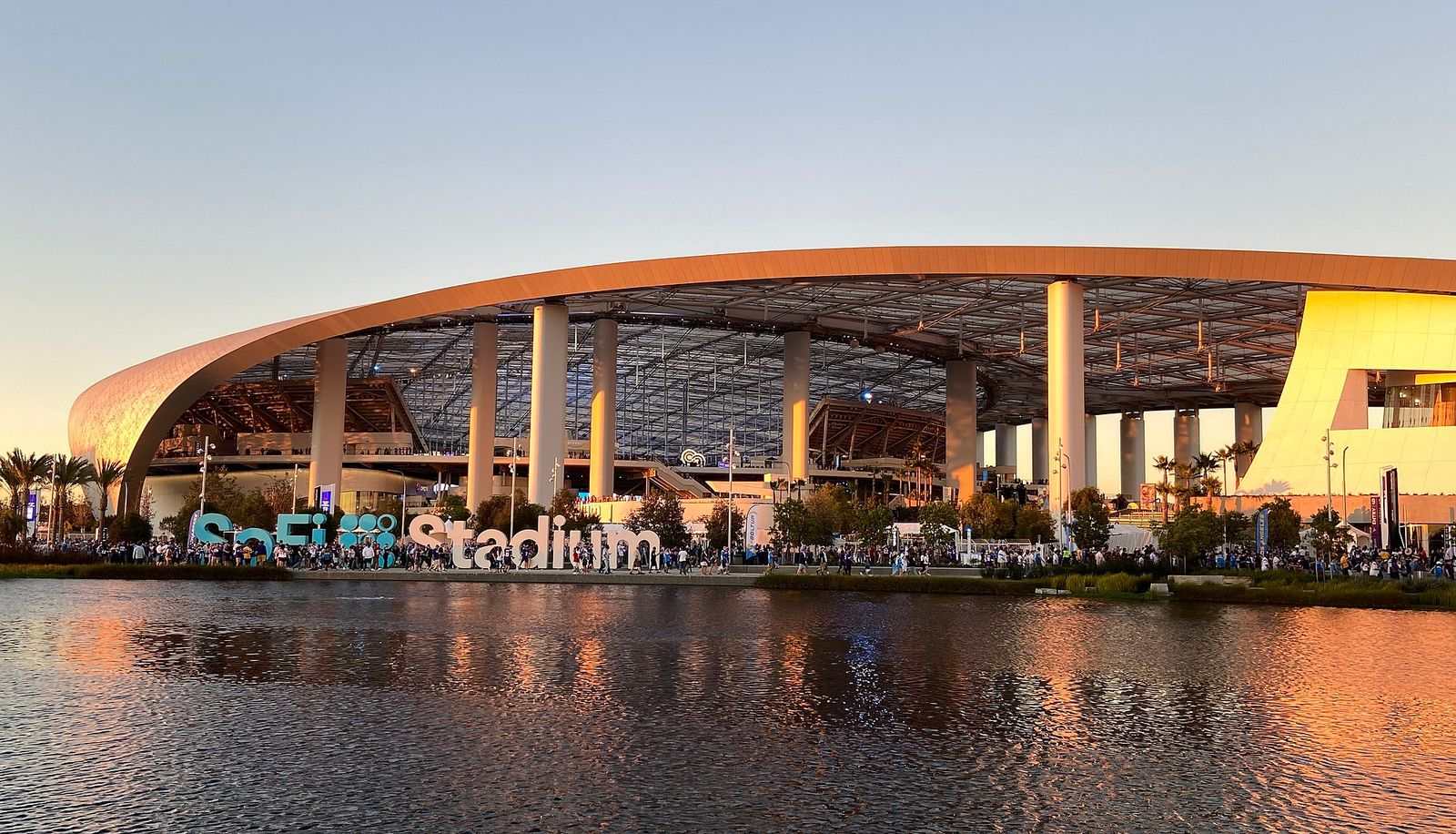
Building a football stadium is one of the most concrete-intensive projects in construction. A single large stadium uses more concrete than an entire city block of high-rise buildings.
That scale matters for your estimates. The ratios from stadium construction apply directly to commercial buildings, large foundations, and parking structures.
Quick Answer: How Much Concrete Does a Stadium Use?
The amount of concrete depends heavily on stadium size, design, and structural system. Here are typical ranges:
| Stadium Size | Seating Capacity | Estimated Concrete Volume |
|---|---|---|
| Small | 20,000–35,000 seats | 30,000–60,000 cu yd |
| Medium | 35,000–60,000 seats | 60,000–100,000 cu yd |
| Large | 60,000–80,000 seats | 100,000–150,000 cu yd |
| Very Large | 80,000+ seats | 150,000–250,000+ cu yd |
Estimates based on typical stadium construction standards. Actual volumes vary by structural system, soil conditions, and design.
Breaking Down Stadium Concrete Usage
A stadium uses concrete across several structural systems, each with different requirements.
Foundation and Substructure (40–50% of total)
The foundation is the largest single consumer of concrete in any stadium. This includes:
- Pile caps and grade beams — transfer loads from columns to deep piles
- Mat foundations — used where soil conditions require load distribution across a wide area
- Below-grade walls — retaining walls, utility tunnels, and service corridors
- Slab-on-grade — ground-level floors for concourses, locker rooms, and mechanical spaces
Foundation concrete uses a 4,000–5,000 PSI mix. In seismic zones like California and the Pacific Northwest, foundations need more steel and higher-strength mixes — up to 6,000 PSI.
Seating Bowl and Decks (30–40%)
The seating bowl is the most visible concrete structure. It consists of:
- Precast raker beams — the sloped structural members that support seating rows
- Precast seating planks — individual seat platforms, often manufactured off-site
- Cast-in-place concourse slabs — the walkways between seating sections
- Stair towers and ramps — vertical circulation throughout the bowl
Precast concrete is the standard for seating elements. It’s made in a factory, quality-controlled, and faster to install. A 70,000-seat stadium uses 3,000–5,000 individual precast pieces.
Structural Columns and Cores (10–20%)
Vertical load-carrying elements include:
- Concrete columns — support upper decks and roof structures
- Shear walls and cores — resist lateral loads from wind and seismic forces
- Elevator and stair shafts — cast-in-place concrete cores
High-strength concrete (6,000–8,000 PSI) is common for lower-level columns in large stadiums where loads are greatest.
Real-World Examples: 2026 World Cup Stadiums
SoFi Stadium — Inglewood, California
SoFi Stadium is the most concrete-data-rich example available for a modern NFL venue.
- Capacity: 70,240 (expandable to 100,240)
- Opened: September 2020
- Construction cost: ~$5 billion (including Hollywood Park development)
- Concrete volume: Over 76,000 cubic yards of structural concrete[1]
- Special mix: Fiber-reinforced concrete used for upper-deck seating planks[2]
- Architect: HKS, Inc. | Contractor: Turner Construction + AECOM Hunt
Morley Builders, a concrete subcontractor on the project, reported the 76,000 cu yd figure. It covers structural concrete only — foundations, columns, concourse slabs, and seating bowl.
The field sits about 100 feet below grade. That below-grade design adds significant substructure volume compared to at-grade stadiums.
At 76,000 cu yd, that’s roughly 7,600 concrete truck loads (at 10 cu yd per truck).
MetLife Stadium — East Rutherford, New Jersey
MetLife is the largest stadium hosting 2026 World Cup matches and the venue for the Final.
- Capacity: 82,500
- Opened: April 2010
- Construction cost: ~$1.6 billion
- Concrete volume: Not publicly disclosed
- Architect: EwingCole | Contractor: Skanska
The team reused 100,000 tons of recycled materials from the demolished Giants Stadium.[3] Engineers estimate concrete volume at 120,000–150,000 cu yd based on comparable stadium standards. No official figure has been published.
Mercedes-Benz Stadium — Atlanta, Georgia
- Capacity: 71,000 (expandable to 75,000 for World Cup)
- Opened: August 2017
- Construction cost: ~$1.6 billion
- Concrete volume: Not publicly disclosed
- Architect: HOK | Contractor: Holder Construction + Hunt Construction Group + H.J. Russell & Company + C.D. Moody Construction
Mercedes-Benz Stadium’s eight-panel retractable roof weighs 1,600 tons per panel. Those loads required massive concrete foundations. Engineers estimate concrete volume at 90,000–120,000 cu yd based on stadium size — no official figure has been published.
How to Calculate Concrete for Your Project
The basic formula for concrete volume:
Volume (cu yd) = Length (ft) × Width (ft) × Depth (ft) ÷ 27
For a stadium-scale foundation slab — say 600 ft × 400 ft × 2 ft thick:
600 × 400 × 2 ÷ 27 = 17,778 cu yd for that slab alone
For complex projects with multiple shapes, our Concrete Calculator handles slabs, footings, columns, and walls with automatic unit conversion.
Scaling from Stadium Data
Stadium data gives you real benchmarks for large commercial projects. Here are two useful ratios:
- Per seat: SoFi Stadium works out to roughly 1.08 cu yd per seat (76,000 ÷ 70,240)
- Per square foot: A 2-million sq ft stadium at 120,000 cu yd = 0.06 cu yd per sq ft
Use these as rough guides only. A parking structure uses far more concrete per sq ft than an office building.
Factors That Affect Stadium Concrete Requirements
Soil Conditions
Poor soil — soft clay, fill, or high water table — means deeper foundations and more concrete. SoFi Stadium’s below-grade design added significant substructure volume. Hard Rock Stadium in Miami faces the same problem: sandy soil with a high water table.
Seismic Zone
Stadiums in California (SoFi, Levi’s, Mercedes-Benz) and the Pacific Northwest (Lumen Field) need seismically designed concrete frames with more reinforcing steel and higher-strength mixes. That raises both material cost and volume.
Structural System
- Cast-in-place concrete frame: More concrete, slower construction, better for complex geometries
- Precast concrete: Less waste, faster assembly, requires precise engineering
- Steel frame with concrete decks: Less total concrete but more steel — common in NFL stadiums
Roof Design
A retractable roof (NRG Stadium, Mercedes-Benz Stadium) needs massive concrete foundations to support the roof mechanism loads. A fixed canopy (Hard Rock Stadium’s 2016 renovation) adds less foundation demand.
Concrete Mix Specifications for Stadium Construction
| Application | Typical PSI | Key Requirements |
|---|---|---|
| Pile caps / mat foundations | 4,000–5,000 | Low w/c ratio, sulfate resistance |
| Structural columns | 5,000–8,000 | High strength, tight tolerances |
| Precast seating planks | 5,000–6,000 | Factory-controlled, fiber reinforcement |
| Concourse slabs | 4,000–4,500 | Wear resistance, freeze-thaw durability |
| Exterior flatwork | 3,500–4,000 | Air entrainment for freeze-thaw |
For more on PSI ratings and mix design, see our Concrete PSI and Mix Design Guide.
Frequently Asked Questions
How many concrete trucks does it take to build a stadium?
For a large NFL stadium using roughly 100,000–150,000 cubic yards of concrete, you’d need about 10,000–15,000 truck loads (at 10 cu yd per truck). Concrete arrives in phases over 2–3 years, not all at once. Foundation pours alone can need hundreds of trucks per day at peak.
How long does it take to pour concrete for a stadium?
Concrete work spans 18–30 months of the construction schedule. Foundations take 6–9 months, the seating bowl 9–12 months, and structural elements are poured throughout. Large mat foundation pours often run 24 hours straight to avoid cold joints.
What type of concrete is used in stadium construction?
Stadiums use several mixes depending on where the concrete goes. Foundations use 4,000–5,000 PSI. Structural columns use 6,000–8,000 PSI. Precast seating elements use 5,000–6,000 PSI with fiber reinforcement. Exterior flatwork uses air-entrained concrete for freeze-thaw resistance.
How much does stadium concrete cost?
Ready-mix concrete for commercial projects runs $150–$250 per cubic yard installed — materials, labor, and pumping. For a 100,000 cu yd stadium, concrete alone costs $15–25 million. That’s a small share of the total; steel, mechanical, and electrical systems dominate the budget.
Can you use concrete blocks instead of poured concrete for a stadium?
CMU blocks work for non-structural interior walls, utility rooms, and partitions. Load-bearing elements — columns, foundations, seating bowl — need cast-in-place or precast reinforced concrete. CMU is common for locker room walls, concession enclosures, and storage areas. Our Concrete Block Calculator calculates block quantities for these applications.
Calculate Your Concrete Needs
Use our Concrete Calculator to calculate volume for foundations, slabs, columns, and walls. For base and drainage layers, the Gravel Calculator gives you aggregate quantities in seconds.
References
[1] Morley Builders — SoFi Stadium project page: https://www.morleybuilders.com/project-experience/sofi-stadium/
[2] For Construction Pros — Fiber-reinforced concrete at SoFi Stadium: https://www.forconstructionpros.com/concrete/news/22043505/the-fiberreinforced-concrete-at-sofi-stadium
[3] Thornton Tomasetti — MetLife Stadium materials reuse: https://www.thorntontomasetti.com/project/metlife-stadium
[4] Wikipedia — SoFi Stadium: https://en.wikipedia.org/wiki/SoFi_Stadium
[5] Wikipedia — MetLife Stadium: https://en.wikipedia.org/wiki/MetLife_Stadium
[6] HOK — Mercedes-Benz Stadium project page: https://www.hok.com/projects/view/mercedes-benz-stadium
[7] CS Engineer Magazine — Engineering SoFi Stadium: https://csengineermag.com/a-stadium-fit-for-super-bowls-engineering-sofi-stadium/
How we checked this page
- • Formulas checked against trade and source material
- • Verified against: ACI guidance and standard concrete estimating practices, ASTM concrete references where mix or material specifications matter, Current U.S. concrete pricing benchmarks
- • Price ranges used for planning, not as fixed quotes
- • This concrete content is scoped for U.S. planning and estimating workflows, not for stamped engineering or permit approval.
- • We review formulas, material assumptions, and practical steps against category-appropriate references before publishing updates.
- • We refresh pages when calculator logic, supplier assumptions, or pricing guidance materially changes.
- • Readers should confirm final dimensions, structural requirements, and local code obligations with qualified local professionals.