The 2026 FIFA World Cup spans three countries and 16 venues. It’s the largest World Cup in history. For contractors, these stadiums show large-scale concrete and structural work at its peak. This guide covers every venue — capacity, construction cost, and key building details.
Why Stadium Construction Data Matters for Contractors
Stadium projects compress years of material procurement and concrete pours into tight schedules. The techniques apply directly to commercial projects. Precast seating systems, high-strength mixes, and deep foundations all show up in warehouses, parking structures, and large foundations.
If you can read a stadium build, you can estimate a warehouse, a parking structure, or a large foundation. The ratios hold.
All 16 World Cup 2026 Venues at a Glance
| Stadium | City | Country | Capacity[1] | Built / Renovated | Est. Cost |
|---|---|---|---|---|---|
| MetLife Stadium | East Rutherford, NJ | USA | 82,500 | 2010 | $1.6B[2] |
| AT&T Stadium | Arlington, TX | USA | 80,000 | 2009 | $1.15B[3] |
| Estadio Azteca | Mexico City | Mexico | 87,523 | 1966 / 2026 | $75M renovation[4] |
| Arrowhead Stadium | Kansas City, MO | USA | 76,416 | 1972 / 2010 | $375M renovation[5] |
| SoFi Stadium | Inglewood, CA | USA | 70,240 | 2020 | $5B[6] |
| Mercedes-Benz Stadium | Atlanta, GA | USA | 71,000 | 2017 | $1.6B[7] |
| NRG Stadium | Houston, TX | USA | 72,220 | 2002 | $352M[8] |
| Lumen Field | Seattle, WA | USA | 68,740 | 2002 | $430M[9] |
| Levi’s Stadium | Santa Clara, CA | USA | 68,500 | 2014 | $1.27B[10] |
| Lincoln Financial Field | Philadelphia, PA | USA | 67,594 | 2003 | $512M[11] |
| Hard Rock Stadium | Miami Gardens, FL | USA | 64,767 | 1987 / 2016 | $755M renovation[12] |
| Gillette Stadium | Foxborough, MA | USA | 64,628 | 2002 | $325M[13] |
| BC Place | Vancouver, BC | Canada | 54,500 | 1983 / 2011 | CA$514M renovation[14] |
| Estadio BBVA | Monterrey | Mexico | 53,529 | 2015 | $200M[15] |
| Estadio Akron | Guadalajara | Mexico | 49,813 | 2010 | $200M[16] |
| BMO Field | Toronto, ON | Canada | 45,736* | 2007 / 2016 | CA$120M expansion[17] |
*BMO Field capacity reflects 2026 World Cup expansion from current 28,180.
Cost figures are construction/renovation costs as officially reported or widely cited. Concrete volumes are estimated based on stadium size and typical construction standards where official data is not publicly available.
United States Stadiums
MetLife Stadium — East Rutherford, New Jersey
The World Cup Final venue.
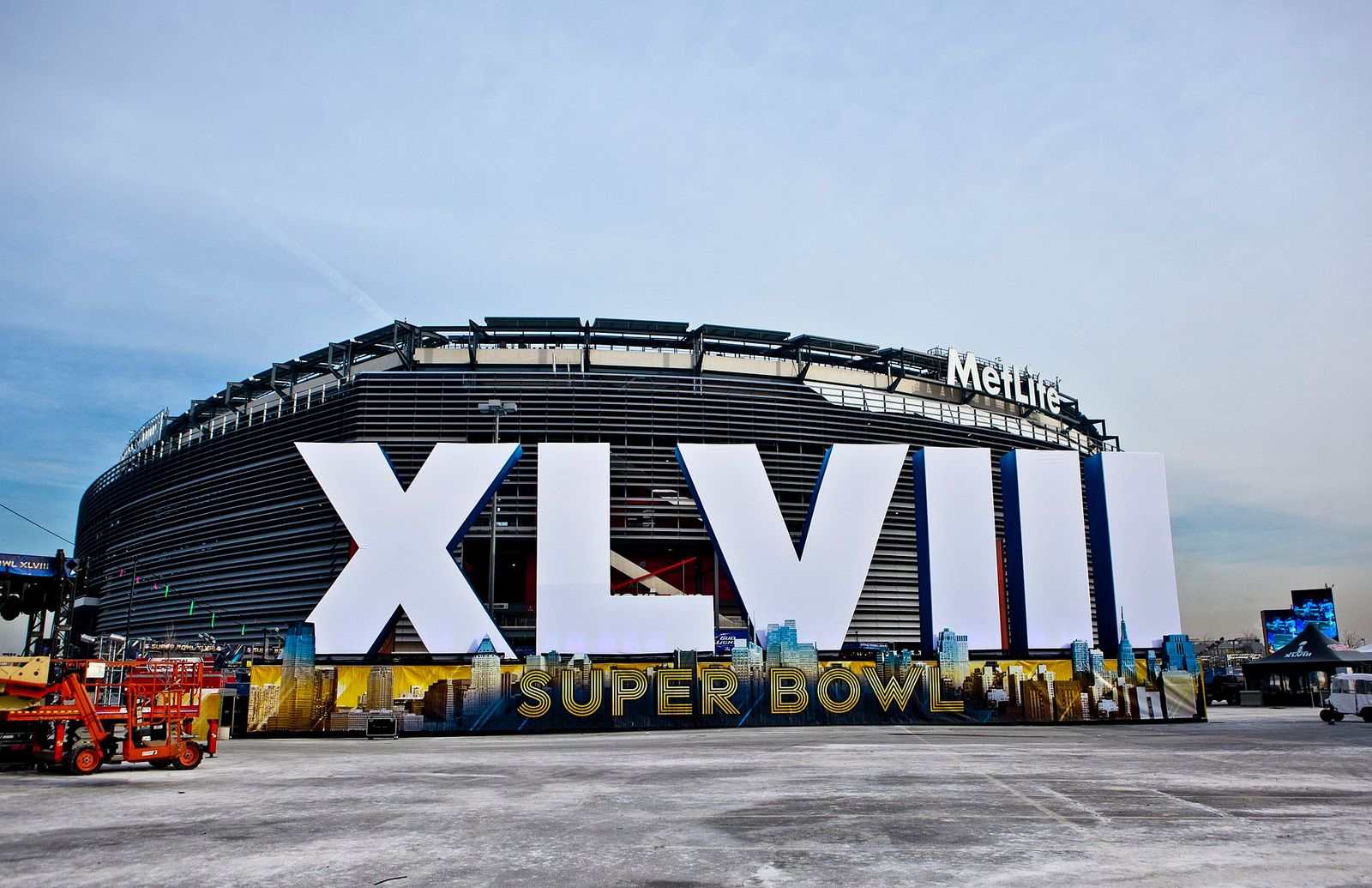
- Capacity: 82,500[1]
- Opened: April 2010
- Construction cost: ~$1.6 billion[2]
- Concrete volume: ~120,000–150,000 cu yd (estimated based on stadium size and typical construction standards; not publicly disclosed)
- Architect: EwingCole
- Contractor: Skanska
- Key feature: The only NFL stadium shared by two teams — Giants and Jets. The design uses neutral branding throughout. The team reused 100,000 tons of materials from the demolished Giants Stadium.[18]
MetLife hosts the Final on July 19, 2026. Its open-air design covers 2.2 million sq ft — one of the most material-intensive stadiums in North America.
Our Concrete Calculator calculates volume for foundations and slabs at this scale — enter your dimensions and it returns the number instantly.
AT&T Stadium — Arlington, Texas
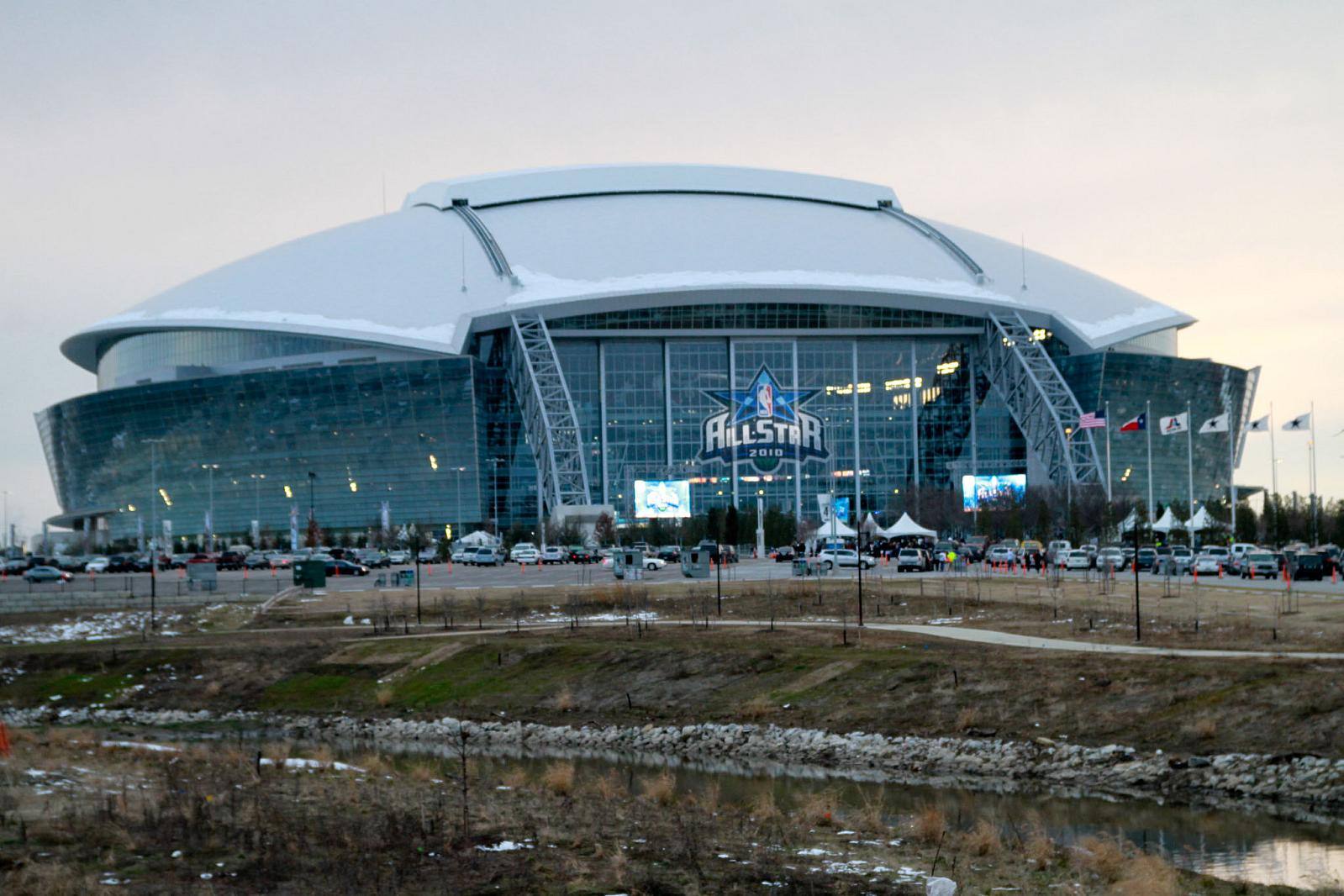
- Capacity: 80,000 (expandable to 100,000+)[3]
- Opened: May 2009
- Construction cost: ~$1.15 billion[3]
- Concrete volume: Not publicly disclosed; excavation exceeded 1.4 million cu yd of earth
- Architect: HKS, Inc.
- Contractor: Manhattan Construction / Rayco / 3i Construction
- Key feature: Two 292-foot steel arches span the entire roof — among the tallest in the world. At opening, the center-hung video board (72×168 ft) was the world’s largest HDTV display.
The 1.4 million cu yd excavation gives a sense of the substructure scale. Concrete volume for the structure itself is not officially published — but for a 3-million sq ft building, it would be substantial.
SoFi Stadium — Inglewood, California
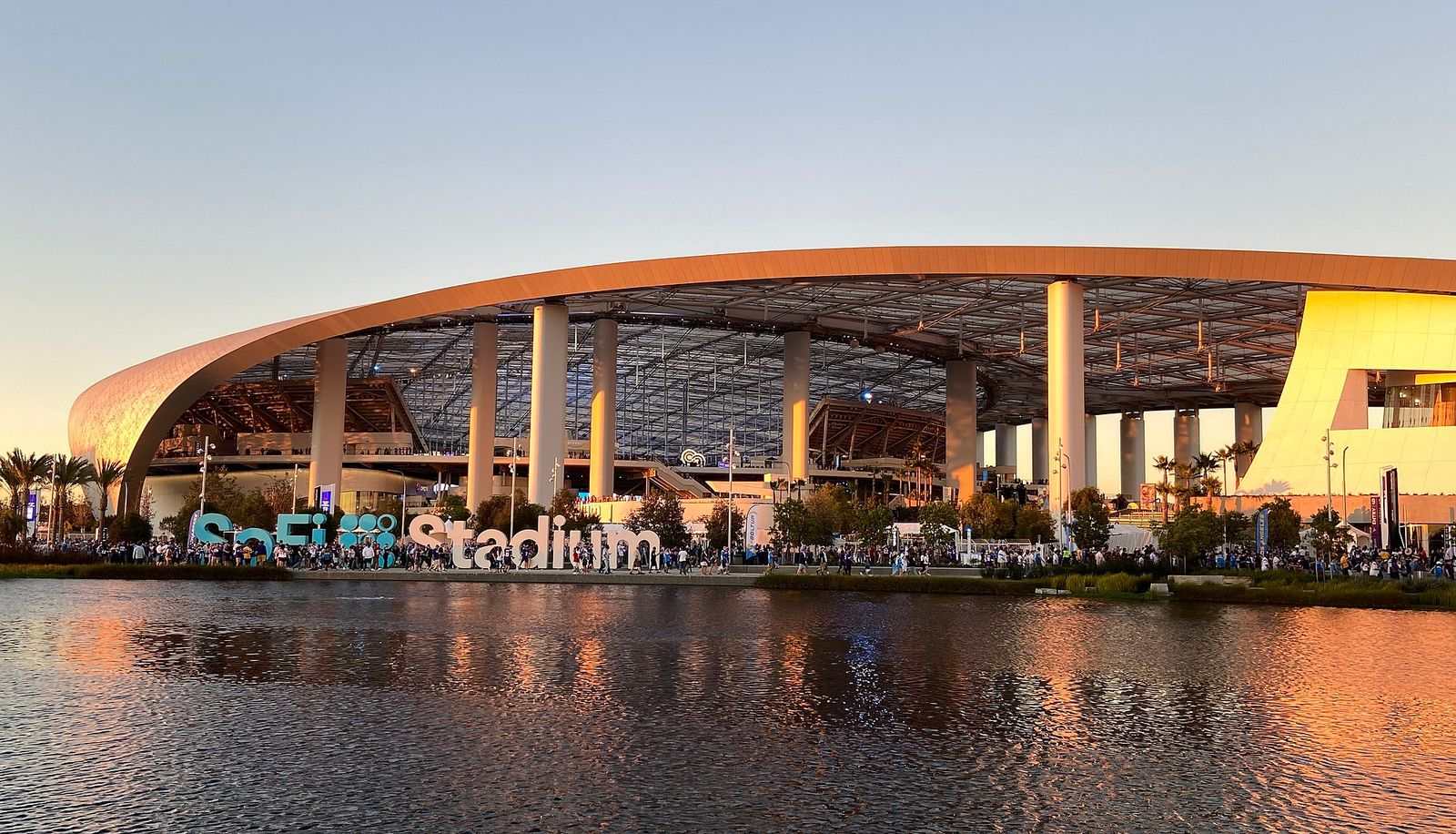
- Capacity: 70,240 (expandable to 100,240)[6]
- Opened: September 2020
- Construction cost: ~$5 billion (including Hollywood Park development)[6]
- Concrete volume: Over 76,000 cu yd of structural concrete[19]
- Architect: HKS, Inc.
- Contractor: Turner Construction + AECOM Hunt
- Key feature: The field sits ~100 feet below grade. This cuts wind exposure and creates a natural thermal buffer. The translucent ETFE roof covers the seating bowl and surrounding plaza — the largest single-roof indoor stadium in NFL history.
SoFi is the only 2026 World Cup venue with a publicly documented concrete volume. Morley Builders, a concrete subcontractor, reported 76,000 cu yd of structural concrete.[19] The team used fiber-reinforced concrete for upper-deck seating planks to control cracking.[20]
Mercedes-Benz Stadium — Atlanta, Georgia
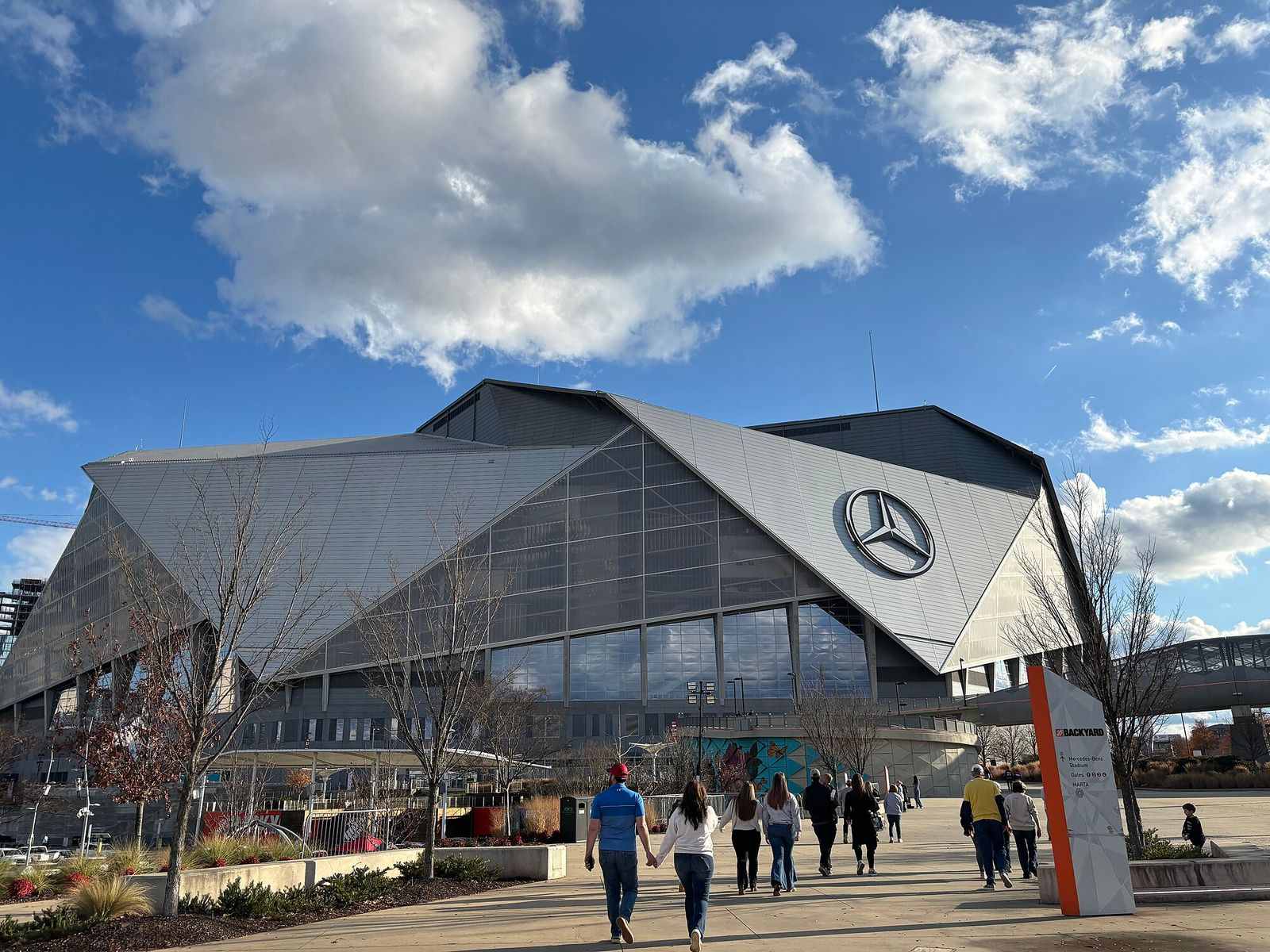
- Capacity: 71,000 (75,000 for World Cup)[7]
- Opened: August 2017
- Construction cost: ~$1.6 billion[7]
- Concrete volume: Not publicly disclosed
- Architect: HOK
- Contractor: Holder Construction + Hunt Construction Group + H.J. Russell & Company + C.D. Moody Construction
- Key feature: Eight-panel retractable roof with a central oculus — the design draws from the Pantheon. Each roof panel weighs 1,600 tons. First professional sports stadium in North America to earn LEED Platinum.
NRG Stadium — Houston, Texas
- Capacity: 72,220[8]
- Opened: August 2002
- Construction cost: $352 million[8]
- Concrete volume: Not publicly disclosed
- Architect: HOK Sport; Houston Stadium Consultants (Lockwood, Andrews & Newnam + Hermes Architects)
- Contractor: Manhattan/Beers joint venture
- Key feature: The first NFL stadium with a retractable roof. It opens or closes in about 10 minutes. 196 luxury suites — among the most in the NFL.
Lumen Field — Seattle, Washington
- Capacity: 68,740[9]
- Opened: July 2002
- Construction cost: $430 million[9]
- Concrete volume: Not publicly disclosed
- Architect: Ellerbe Becket; LMN Architects
- Contractor: Turner Construction
- Key feature: Open-air design with three enclosed sides creates a noise funnel. Fans set the Guinness World Record for loudest outdoor stadium twice — 2013 and 2014. First NFL stadium to install FieldTurf.
Levi’s Stadium — Santa Clara, California
- Capacity: 68,500 (expandable to 75,000)[10]
- Opened: July 2014
- Construction cost: ~$1.27–1.3 billion[10]
- Concrete volume: Not publicly disclosed
- Architect: HNTB; Gensler (interiors)
- Contractor: Turner Construction + Devcon Construction
- Key feature: Built in 819 days — one of the fastest NFL stadium timelines. Has a rooftop green space and solar panels generating 375 kW. Extensive technology infrastructure throughout.
Lincoln Financial Field — Philadelphia, Pennsylvania
- Capacity: 67,594[11]
- Opened: August 2003
- Construction cost: $512 million[11]
- Concrete volume: Not publicly disclosed
- Architect: NBBJ; Agoos Lovera Architects
- Contractor: Turner Construction; Keating Building Corp.; McKissack Group
- Key feature: Philadelphia and Pennsylvania contributed ~$188 million in public funding. The city owns the stadium and leases it to the Eagles. Over 624 linear feet of LED ribbon boards throughout.
Hard Rock Stadium — Miami Gardens, Florida
- Capacity: 64,767[12]
- Opened: August 1987; major renovation completed 2016
- Original construction cost: $115 million[12]
- Renovation cost: $550–755 million (2015–2016, privately funded by owner Stephen Ross)[12]
- Concrete volume: Not publicly disclosed
- Architect: HOK Sport (original); HOK Architecture (renovation)
- Contractor: Huber, Hunt & Nichols (original)
- Key feature: The 2016 renovation added a cantilevered shade canopy and moved seating 25 feet closer to the field. The stadium now holds one of the world’s largest street art collections — 18 artists from 10 countries.
Gillette Stadium — Foxborough, Massachusetts
- Capacity: 64,628[13]
- Opened: May 2002
- Construction cost: $325 million[13]
- Concrete volume: Not publicly disclosed
- Architect: HOK Sport
- Contractor: Skanska; Barton Malow (project manager)
- Key feature: Entirely privately funded by the Kraft family — no public money. One of the few NFL stadiums with full private ownership. Originally named CMGI Field; renamed after the dot-com bust.
Mexico Stadiums
Estadio Azteca — Mexico City, Mexico
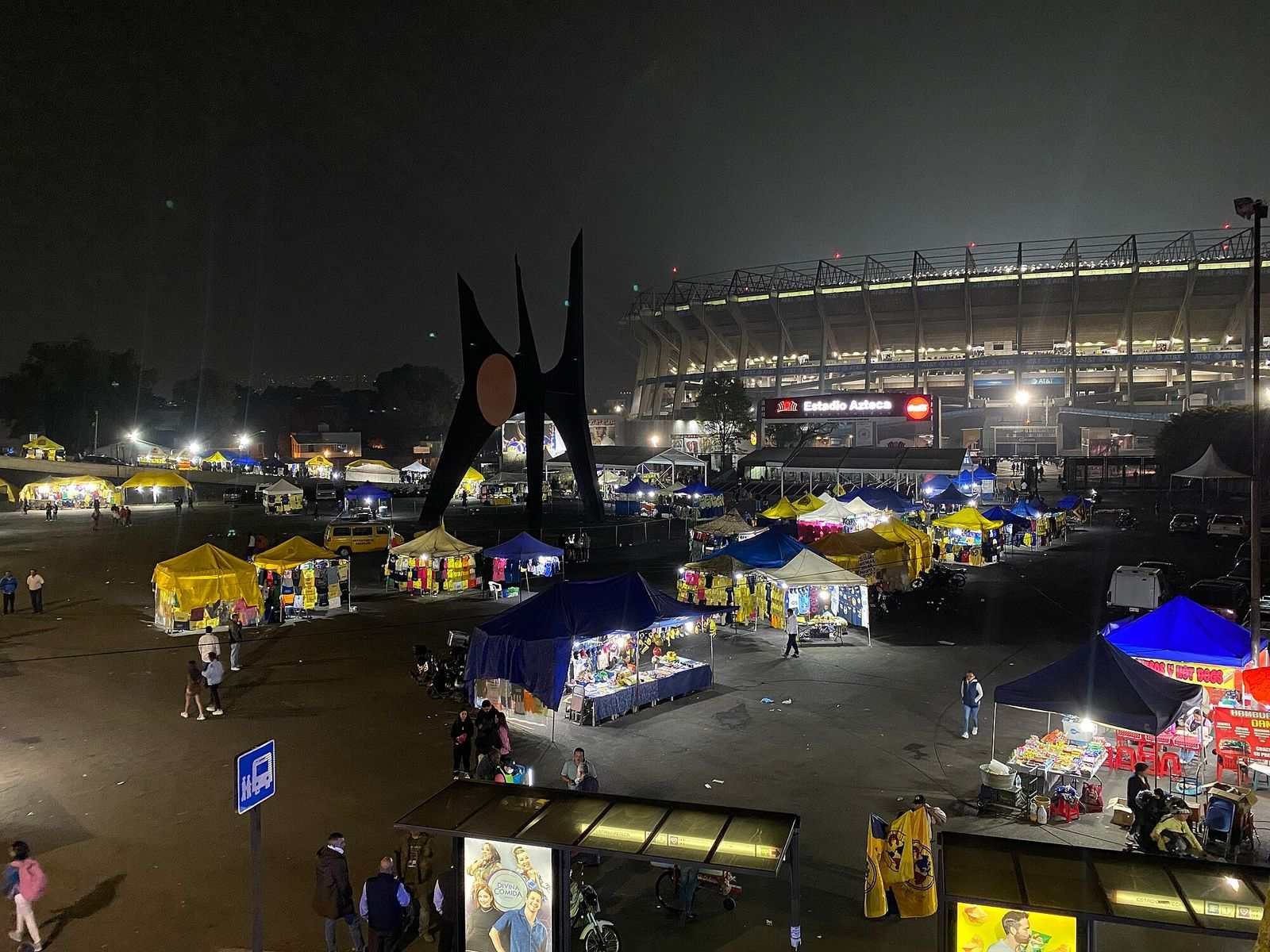
The only stadium to host three FIFA World Cups (1970, 1986, 2026).
- Capacity: 87,523 (post-2026 renovation)[4]
- Opened: May 1966; major renovation completed March 2026
- Original construction cost: MXN $260 million (1966)[4]
- 2024–2026 renovation cost: ~$75 million USD[4]
- Concrete volume: Not publicly disclosed
- Architect: Pedro Ramírez Vázquez and Rafael Mijares Alcérreca (original)
- Key feature: Sits at 2,200 meters (7,200 ft) — the highest-altitude World Cup venue. The 2024–2026 renovation updated facilities while keeping the iconic bowl. Original capacity was 107,494; later renovations cut it to improve sightlines.
Estadio BBVA — Monterrey, Mexico
- Capacity: 53,529[15]
- Opened: August 2015
- Construction cost: ~$200 million[15]
- Concrete volume: Not publicly disclosed
- Architect: Populous / VFO / Federico Velasco
- Contractor: Aceros Lozano, GGP, Maíz Mier
- Key feature: Nicknamed “El Gigante de Acero” (The Steel Giant) for its exposed steel structure. Entirely privately funded by FEMSA. One of the most modern football-specific stadiums in Latin America.
Estadio Akron — Guadalajara, Mexico
- Capacity: 49,813[16]
- Opened: July 2010
- Construction cost: ~$200 million[16]
- Concrete volume: Not publicly disclosed
- Architect: Jean Marie Massaud & Daniel Pouzet (concept); Populous (sports architect); VFO Architects (architect of record)
- Key feature: UFO/flying saucer exterior with semi-transparent cladding. 133 luxury suites — the most of any stadium in Mexico. The design drew from a floating disc above the landscape.
Canada Stadiums
BC Place — Vancouver, British Columbia
- Capacity: 54,500 (football configuration)[14]
- Opened: June 1983; roof renovation completed 2011
- Original construction cost: CA$356 million[14]
- 2011 renovation cost: CA$514 million (including new retractable cable-supported roof)[14]
- Concrete volume: Not publicly disclosed
- Architect: Studio Phillips Barratt (original); Stantec Architecture (renovation)
- Contractor: Dillingham Construction (original); PCL Westcoast Constructors (roof renovation)
- Key feature: Originally the world’s largest air-supported dome. The 2011 renovation replaced it with a retractable cable-supported roof — the largest of its type at the time, with a 100×85 meter opening.
BMO Field — Toronto, Ontario
- Capacity: 45,736 (2026 World Cup expansion)[17]
- Opened: April 2007; expanded 2016
- Original construction cost: CA$62.9 million[17]
- 2014–2016 expansion cost: CA$120 million[17]
- Concrete volume: Not publicly disclosed
- Architect: Brisbin Brooks Beynon Architects; Gensler (expansion)
- Contractor: PCL Construction
- Key feature: One of the few North American stadiums built for soccer, later adapted for Canadian football. The 2026 expansion grows capacity from 28,180 to 45,736 — the largest proportional expansion of any venue in this tournament.
Construction Material Breakdown
Concrete Requirements
Across the 16 venues, concrete is the dominant structural material. The only publicly documented volume is SoFi Stadium at 76,000 cu yd. For context:
- A typical 3,000 sq ft residential foundation uses about 30–50 cu yd
- A 50,000 sq ft commercial warehouse foundation uses about 500–1,000 cu yd
- SoFi’s 76,000 cu yd equals roughly 1,500–2,500 residential foundations
Older stadiums (Azteca 1966, Arrowhead 1972) used conventional reinforced concrete throughout. Modern stadiums use precast concrete for seating elements — factory-produced, quality-controlled, and faster to install than cast-in-place.
Steel and Structural Materials
Steel is the second major structural material. Notable examples:
- MetLife Stadium: 40,000 tons of recycled steel from demolished Giants Stadium[18]
- AT&T Stadium: Two 292-ft steel arches spanning the roof
- Mercedes-Benz Stadium: Eight roof panels at 1,600 tons each = 12,800 tons of roof steel alone
- Estadio BBVA: Prominent exposed steel structure (hence “El Gigante de Acero”)
Specialty Materials
- ETFE membrane: SoFi Stadium and Mercedes-Benz Stadium use ETFE panels for translucent roofing. They’re lightweight, durable, and self-cleaning.
- Retractable roof systems: NRG Stadium, Mercedes-Benz Stadium, and BC Place each use specialized cable, track, and drive systems.
- Artificial turf: Several venues use FieldTurf or similar systems. FIFA 2026 requires natural grass, so some venues need temporary conversions.
How to Estimate Construction Materials for Your Project
Stadium-scale data gives you real benchmarks for large commercial projects. Whether you’re planning a sports facility, warehouse, or large foundation:
- Use our Concrete Calculator to calculate volume for foundations, slabs, columns, and walls
- For base course and drainage aggregate, the Gravel Calculator gives you aggregate quantities in seconds
- For retaining walls or CMU construction, the Concrete Block Calculator estimates block counts and mortar
Frequently Asked Questions
Which 2026 World Cup stadium is the largest?
Estadio Azteca seats 87,523 after its 2026 renovation. MetLife Stadium follows at 82,500 and hosts the Final. AT&T Stadium seats 80,000 and can expand beyond 100,000.
Which is the newest 2026 World Cup stadium?
SoFi Stadium opened in September 2020 — the newest venue. Mercedes-Benz Stadium (2017) and Levi’s Stadium (2014) are next. Estadio Azteca (1966) is the oldest, though it completed a major renovation in 2024–2026.
How much does it cost to renovate a stadium for the World Cup?
Costs vary widely by scope. Estadio Azteca’s 2024–2026 renovation cost about $75 million. Hard Rock Stadium’s 2015–2016 renovation cost $550–755 million. BC Place’s 2011 roof renovation cost CA$514 million. A new roof, expanded capacity, or full modernization each push costs higher.
Are any 2026 World Cup stadiums newly built?
No. All 16 venues are existing stadiums — NFL, MLS, and international football facilities. BMO Field in Toronto is undergoing the largest proportional expansion, growing from 28,180 to 45,736 seats.
What is the total combined capacity of all 2026 World Cup stadiums?
The combined capacity of all 16 venues is approximately 1,077,706 seats, ranging from BMO Field at 45,736 to Estadio Azteca at 87,523.
References
[1] Wikipedia — MetLife Stadium: https://en.wikipedia.org/wiki/MetLife_Stadium
[2] Skanska — MetLife Stadium project: https://group.skanska.com/projects/57101/MetLife-Stadium
[3] Wikipedia — AT&T Stadium: https://en.wikipedia.org/wiki/AT%26T_Stadium
[4] StadiumDB — Estadio Azteca renovation: https://stadiumdb.com/news/2025/02/mexico_renovation_cost_of_estadio_azteca_could_reach_75_million
[5] Wikipedia — Arrowhead Stadium: https://en.wikipedia.org/wiki/Arrowhead_Stadium
[6] Wikipedia — SoFi Stadium: https://en.wikipedia.org/wiki/SoFi_Stadium
[7] HOK — Mercedes-Benz Stadium: https://www.hok.com/projects/view/mercedes-benz-stadium
[8] Wikipedia — NRG Stadium: https://en.wikipedia.org/wiki/NRG_Stadium
[9] Wikipedia — Lumen Field: https://en.wikipedia.org/wiki/Lumen_Field
[10] Wikipedia — Levi’s Stadium: https://en.wikipedia.org/wiki/Levi%27s_Stadium
[11] Wikipedia — Lincoln Financial Field: https://en.wikipedia.org/wiki/Lincoln_Financial_Field
[12] Wikipedia — Hard Rock Stadium: https://en.wikipedia.org/wiki/Hard_Rock_Stadium
[13] Wikipedia — Gillette Stadium: https://en.wikipedia.org/wiki/Gillette_Stadium
[14] Wikipedia — BC Place: https://en.wikipedia.org/wiki/BC_Place
[15] Wikipedia — Estadio BBVA: https://en.wikipedia.org/wiki/Estadio_BBVA
[16] Wikipedia — Estadio Akron: https://en.wikipedia.org/wiki/Estadio_Akron
[17] Wikipedia — BMO Field: https://en.wikipedia.org/wiki/BMO_Field
[18] Thornton Tomasetti — MetLife Stadium: https://www.thorntontomasetti.com/project/metlife-stadium
[19] Morley Builders — SoFi Stadium: https://www.morleybuilders.com/project-experience/sofi-stadium/
[20] For Construction Pros — SoFi fiber concrete: https://www.forconstructionpros.com/concrete/news/22043505/the-fiberreinforced-concrete-at-sofi-stadium
How we checked this page
- • Formulas checked against trade and source material
- • Verified against: ACI guidance and standard concrete estimating practices, ASTM concrete references where mix or material specifications matter, Current U.S. concrete pricing benchmarks
- • Price ranges used for planning, not as fixed quotes
- • This concrete content is scoped for U.S. planning and estimating workflows, not for stamped engineering or permit approval.
- • We review formulas, material assumptions, and practical steps against category-appropriate references before publishing updates.
- • We refresh pages when calculator logic, supplier assumptions, or pricing guidance materially changes.
- • Readers should confirm final dimensions, structural requirements, and local code obligations with qualified local professionals.